
Reconstruct the Brooks County Owner Timeline
Every chain begins with the newest matching deed. Let the era and its access limits pick the next source rather than guessing at a missing owner.
| Source | Years It Covers | Where Held | What It Shows |
|---|---|---|---|
| GSCCCA Brooks deed index | Displayed from 1988 through its posted good-through date | Online, with account gates for some access | Names, dates, types, and instrument references |
| Clerk deed books and local indexes | Older and locally retained eras; exact run requires clerk confirmation | Clerk of Superior Court | Earlier recorded conveyances |
| Plat index and recorded plats | Search by the available plat fields | GSCCCA and Clerk | Lot, block, district, land lot, and subdivision clues |
| Historical maps and library holdings | 1866 map; newspapers June 1866 to 1994 | Digital Library of Georgia and local library | Place and name clues for the official search |
Online works well for recent transfers. When the index cutoff, a login gate, or a missing image stops the chain, the Clerk's deed books take over. The official good-through display for Brooks County shows how far the online deed index reaches:
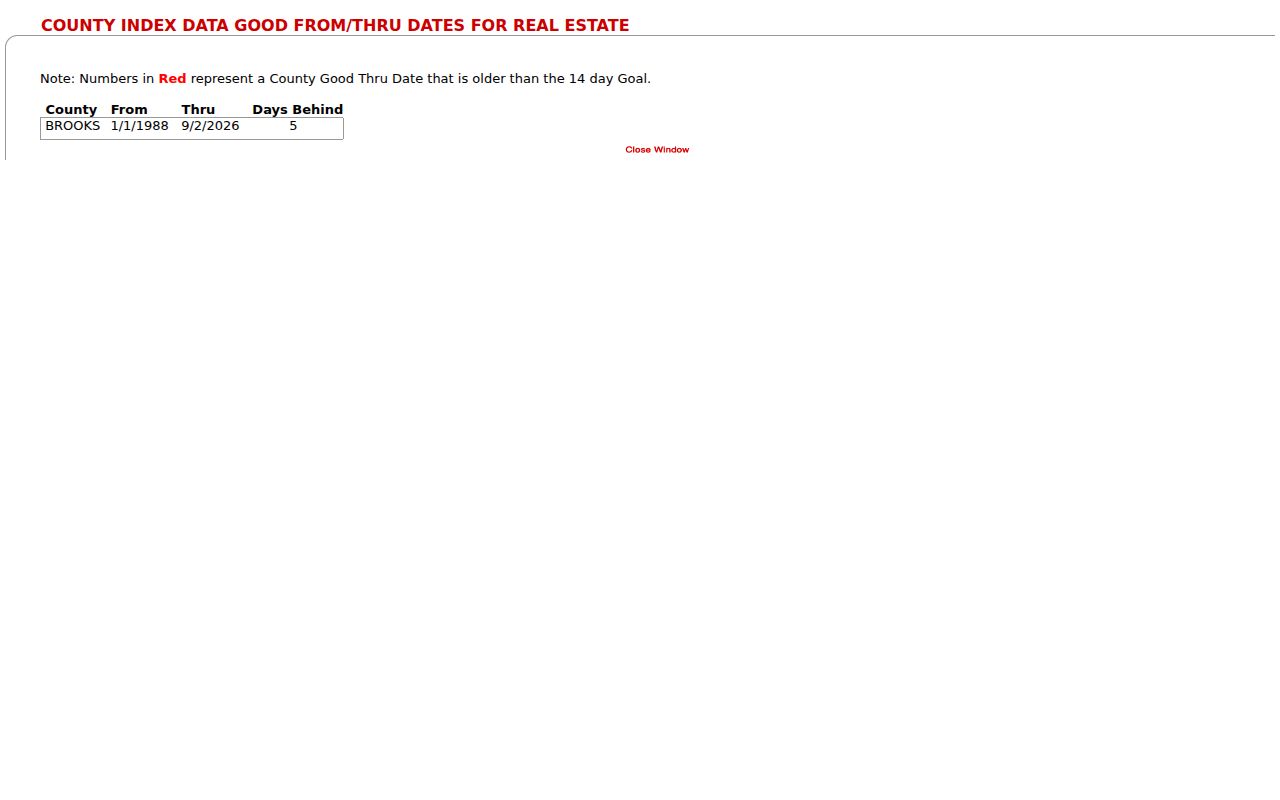
That date marks the reach of the online era, nothing more. Older deed images may still sit in courthouse books rather than the web interface.
The Brooks County Online Trail Has Two Date Displays
Two date displays govern the online trail. The county good-through page covers deeds recorded from January 1, 1988 through September 2, 2026, while the general name form lists January 1, 1990 as its own system start. Treat both as interface facts, not one universal cutoff.
Time-depth limit. Former owners before the verified 1988 Brooks display require Clerk deed books, locally retained indexes, archives, or other historical finding aids.
Go Back Through the Brooks Grantor-Grantee Index
The GSCCCA name index lets you narrow by Party Type, Instrument Type, County, a neighboring-county choice, name, date range, results count, and table-display controls. Pick Brooks County and a transfer-focused instrument type for grantor-grantee work.
- Find the present owner's acquisition as a grantee.
- Copy the grantor, date, deed type, reference, and legal description.
- Search that grantor as a grantee in an earlier date range.
- Repeat while the land description continues to match.
- Log gaps and continue in the deed books rather than guessing.
- Grantor / grantee
- The conveying and receiving parties.
- Chain of title
- The linked sequence of transfers for the same land.
- Legal description
- The land description used to keep an old search on the correct tract.
The captured GSCCCA real-estate name form shows the controls used for that backward loop:
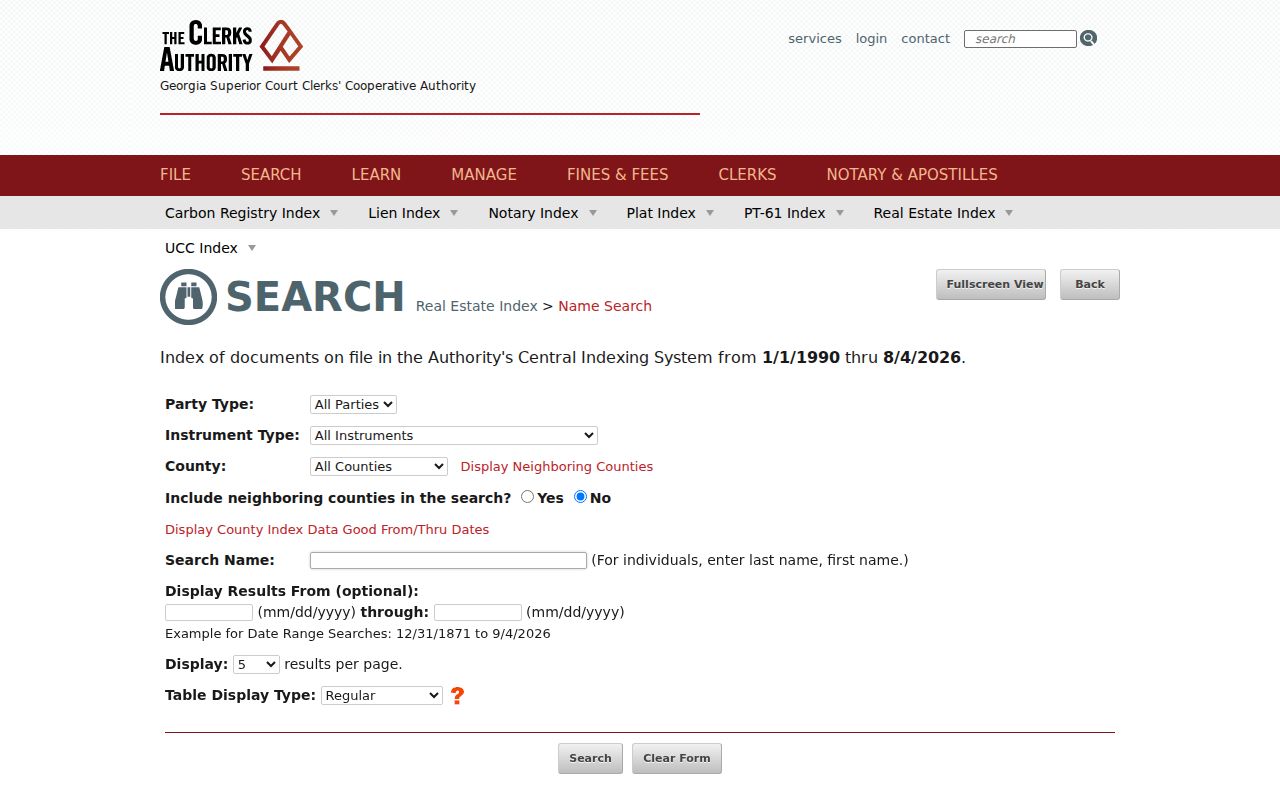
The form lays out its search options plainly. A login redirect still stands between a result and the deed itself, so inspect the instrument at the Clerk's office or request a copy.
Book and Page References Keep Brooks Owners Linked
Tax-sale files show the pattern. Official samples pair deed references like 57/235, 762/187, and 450/627 with map and parcel strings and full legal descriptions. One citation can reopen a stale link. They are samples, not a chain. The book/page search accepts County, Book, and Page entries; if an image sits behind a gate, carry the citation to the Clerk for an existing copy.
Separate Brooks Conveyances from Liens and Releases
Not every filed name is an owner. Warranty, quitclaim, gift, estate, foreclosure, sheriff's, and tax deeds can convey an interest in the land. Security deeds, liens, assignments, and releases track debt. Read the document before adding a name. A tax deed may be followed by redemption or another conveyance, and a quitclaim passes only what the grantor held, so both leave the chain with more work to do.
Brooks County Estates Can Interrupt the Name Loop
Death can push the search off the deed books. Probate Court takes over until a later deed returns the trail to land records. Estate administration, heirs, a deed from an estate, or a court order explain who had authority to transfer. Record each party's capacity. An administrator is not an ordinary past owner. Foreclosure and sheriff's deeds change the party pattern too, so trust the parcel description and instrument role over a familiar surname.
Quitman's Renamed Streets Conceal Older Owners
Quitman's 1838 plat centered on a public square. Most early street names changed later. Franklin and Jackson are the noted exceptions. Old deeds and newspapers may cite an address that bears no resemblance to today's situs. Bridge the gap with lot, block, plat, land-lot, and adjoining-owner language, and count the historic-grid clue only when the legal description keeps you on the same land.
Extend Brooks County History Beyond 1858
Brooks County was born in 1858. Its parents were Lowndes and Thomas counties. Earlier land links may live in their deed books. An 1866 B. A. White Brooks map, made under a December 12, 1866 General Assembly act, adds geographic context but never replaces a deed. Library holdings include Brooks newspapers from June 1866 through 1994, plus cemetery, census, and genealogical resources. FamilySearch and archival maps can surface names and places that lead back to the official record.
Keep Brooks County Deed Types in Separate Lanes
A former-owner chain runs on conveyances, not on every instrument filed under a familiar name. Warranty and quitclaim deeds can transfer an interest. So can gift, estate, foreclosure, sheriff's, and tax deeds in the right context. Security deeds, liens, assignments, and releases generally document a debt, a claim, a transfer of that claim, or its satisfaction, and they may burden the land without ever making the named lender a prior owner. Keep the two lanes separate.
| Instrument clue | Place in the backward chain | Next check |
|---|---|---|
| Warranty or quitclaim deed | Potential conveyance between grantor and grantee | Match the legal description and later transfers |
| Estate or executor's deed | Potential transfer out of an estate | Check the fiduciary capacity and probate context |
| Tax or sheriff's deed | Potential involuntary transfer | Check redemption, confirmation, court, and later deeds |
| Security deed or release | Financing record, not a routine owner link | Keep it off the owner timeline unless another instrument conveys title |
Read the instrument, not the index label. A quitclaim passes only what the grantor held. A warranty label carries different promises, but neither label alone proves a complete, unchallenged title.
Brooks County Plat References Hold the Land Steady
Names drift from deed to deed. Street addresses get added or revised. The land description is the one stable thread. Watch for subdivision, lot, block, plat book or cabinet, district, land lot, acreage, metes and bounds, and adjoining-owner calls. Official Brooks tax-sale files show map and parcel strings sitting beside deed book and page references.
The GSCCCA plat index offers Instrument Type, County, a neighboring-county choice, Search Name, Sec/GMD, District, Land Lot, dates, result count, and display controls. Search Brooks County first. A plat can tie several parcels to one recorded subdivision drawing. It does not give the sequence of former owners.
When a deed says “being the same property conveyed” and cites an earlier book and page, follow that citation directly. It dodges misspelled names in the index.
Estate and Court Events Can Bend the Brooks Chain
A chain of title in Brooks County rarely runs in a perfectly straight line. A death, divorce, foreclosure, quiet-title case, or boundary order can interrupt the simple grantor-to-grantee rhythm. When that happens, look to the courts. Brooks County Probate Court records may explain an administrator. They may also explain an executor, heirs, or someone's authority to sell. Superior Court records may clarify an order referenced in a later instrument. Treat neither source as a conveyance on its own. Only the record and Georgia law can give it that effect.
Use the estate or case file as context. Then go back to the land index. Find the deed, order, or other instrument recorded against the parcel there. Brooks guidance routes Superior and State case access through PeachCourt, which requires an account. Older, certified, sealed, and locally retained files require Clerk confirmation. Keep in mind that a case caption alone proves nothing about ownership.
Beside each name, write the party's role. The role might be decedent, heir, administrator, lender, borrower, plaintiff, defendant, grantor, or grantee. That small habit keeps a person out of the ownership timeline. It stops someone who merely touched the transaction from slipping in by mistake.
Brooks County's 1866 Map Adds Place Context
The Digital Library of Georgia preserves an 1866 map of Brooks County drawn by B. A. White under a December 12, 1866 General Assembly act. It is a fine geography aid for place names and roads. It also shows the early look of the county. It cannot substitute for a deed or survey. No modern parcel card appears on it.
The map works best as a question generator for an old legal description. After it sharpens your questions, verify the tract in the Clerk's deed books and plats. Remember that Brooks County was created in 1858 from Lowndes and Thomas counties. A chain reaching before that year may continue in a parent county's volumes. It may not sit in Brooks at all.
This distinction matters when tracing former owners. A gap at 1858 may reflect a jurisdiction change rather than lost ownership. Record the county, book, page, and date at every step so the trail stays reproducible.
Library Microfilm Can Reopen a Brooks Name Search
Local library holdings include Brooks newspapers from June 1866 through 1994. Cemetery, census, and genealogical material sits there too. These sources can surface name variants, estate notices, sale notices, neighborhood names, or family relationships. Such clues point back to the right deed index entry. They are finding aids, not proof of ownership.
Search the newspapers around a known transfer, death, or foreclosure date. Compare every discovered address or surname against the parcel's legal description and recorded instrument. FamilySearch and archival maps can add index clues. Still, any statement about ownership should cite the deed. The official land record must link the party to the tract.
Note: A newspaper notice can explain why a transfer happened. Only the matching recorded record belongs in the Brooks former-owner chain.
Resolve a Gap in Brooks County Prior Owners
Clerk Belinda Parker's office sits at 1 Screven Street, Suite 6, Quitman. Call 229-263-4747 for help. The staff can help you find the existing index, deed book, or image tied to a name and date range. Older, certified, sealed, and locally retained files require clerk confirmation. When online access fails, phone, mail, and the courthouse counter are your fallbacks.
A Georgia Open Records Act request under O.C.G.A. §§50-18-70 et seq. should identify an existing record. Agencies generally respond within three business days when practicable. Or they give notice of timing, cost, and exemptions.
Lawful use. Brooks County former-owner research supports house history, estate work, and property diligence. Never use the trail to stalk, harass, intimidate, or harm a living person.