
Brooks County Deed Types
Every deed names a grantor, a grantee, the land conveyed, and the stated terms. One filing never tells the whole story. Later instruments matter just as much. Security deeds and liens often sit in the same real-estate index as true conveyances, yet neither passes fee ownership by itself.
| Deed Type | What It Records | Typical Question |
|---|---|---|
| Warranty deed | Transfer with stated title promises | Ordinary sale |
| Quitclaim deed | Whatever interest the signer holds | Family transfer or cleanup |
| Security deed | Georgia loan security interest | Debt, not fee title |
| Executor or administrator deed | Estate representative's transfer | Estate conveyance |
| Tax, sheriff's, or foreclosure deed | Forced-sale transfer | Status after a sale |
A release can end an encumbrance. A later quitclaim can reshape someone's interest in the land. Read the parties, the legal description, the filing date, and the next recording reference as one connected set.
Search Brooks Deeds in GSCCCA
The clerk offers no separate local search form. Instead, use the GSCCCA real-estate name search, pick Brooks County, choose grantor or grantee, and set a sensible date range. Some details and images require an account.
| Index Field | Input | Use |
|---|---|---|
| County | Brooks or statewide | Sets the filing office |
| Party type | Grantor or grantee | Sets the role |
| Name | Person or entity | Finds indexed parties |
| Date range | Start and end | Narrows the period |
| Instrument type | Deed, lien, plat, other | Separates record classes |
Open the official Brooks index shown in the captured screen.
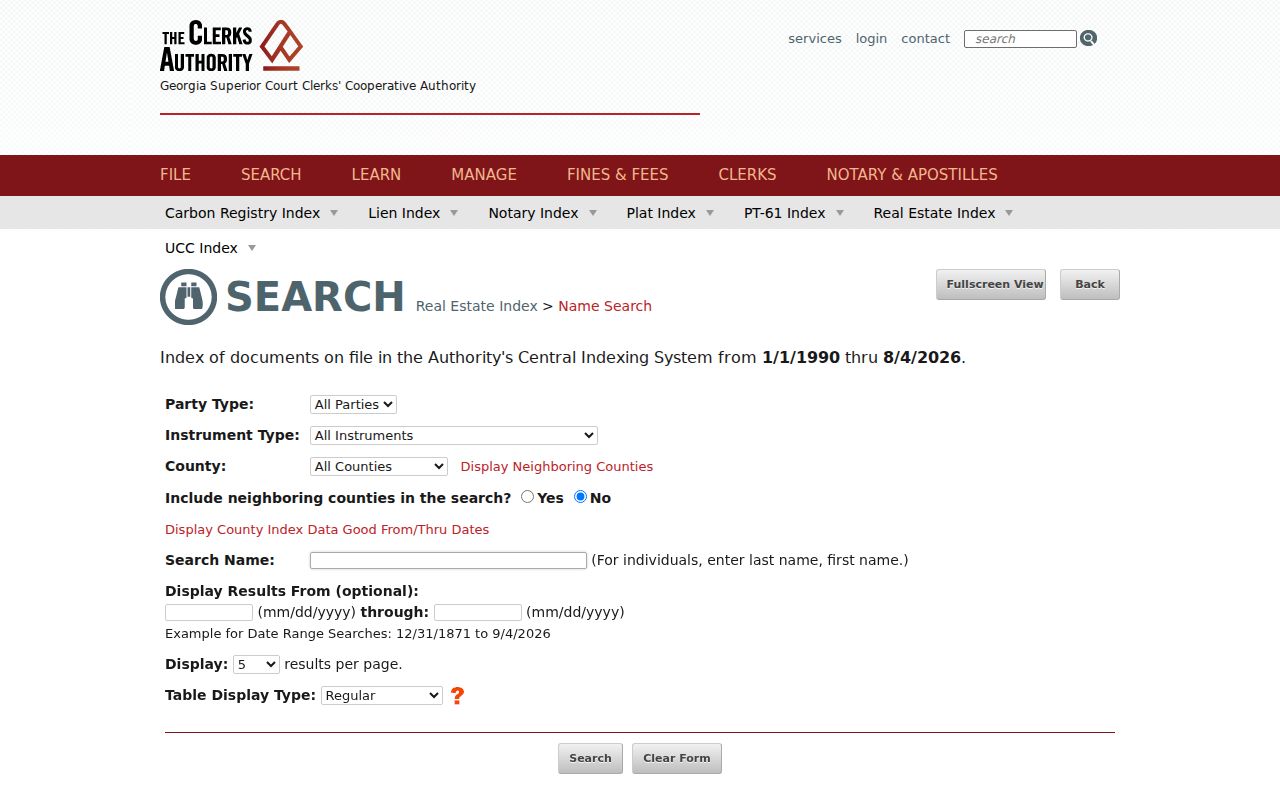
The form itself changes nothing legally. It simply confirms the statewide route and its controls.
Build a Brooks Deed Chain
A chain of title is the ordered run of transfers for one piece of land. The grantor gives an interest; the grantee receives it. Names open the index door. The legal description is what keeps the search locked to a single tract through every change of hand.
- Find the current owner's acquisition deed by searching that owner as grantee.
- Save its date, type, book/page, parties, and exact land description.
- Search that deed's grantor as a grantee in an earlier period.
- Repeat while subdivision, lot, land lot, district, acreage, and plat clues match.
- Move to clerk-held books and parent counties when online coverage ends.
- Grantor
- The party transferring an interest.
- Grantee
- The party receiving it.
- Chain of title
- The linked sequence of conveyances.
- Book/page
- The volume and page retrieval reference.
- Instrument number
- A separate filing identifier, when assigned.
A shared surname proves nothing on its own. Splits, combines, estates, and new plats can rewrite a description while the land itself stays in the family.
Brooks Index Dates Conflict
The GSCCCA good-through display has listed January 1, 1988 through September 2, 2026. A separate system display listed January 1, 1990 through August 4, 2026. The two ranges disagree. If a deed falls near either boundary, ask the clerk or GSCCCA directly. A good-through date only reports the state of the index feed at a moment in time. It says nothing about whether every image is online. It never means older deed records fail to exist.
Check Brooks County's current display before choosing dates.
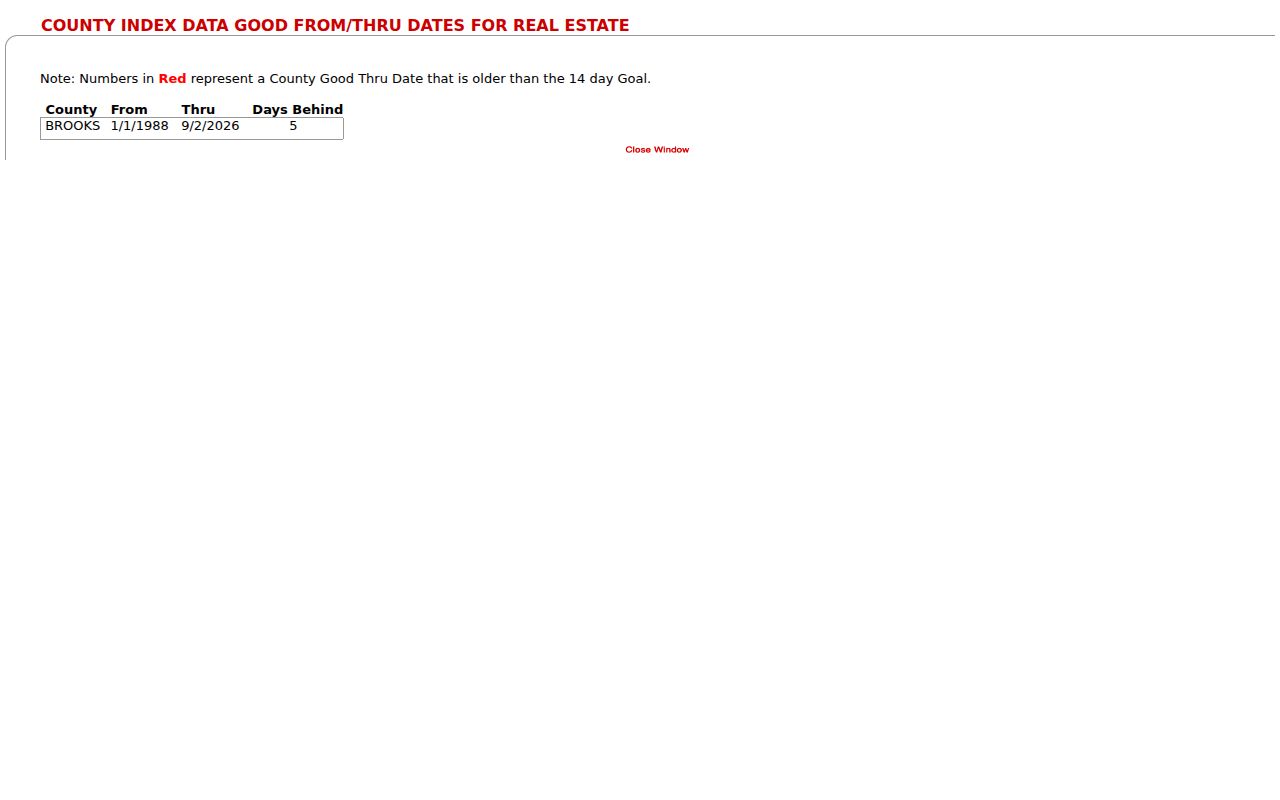
The capture preserves the observed span; current access still requires a live check.
Search Brooks Property Fields
The GSCCCA property search opens another route. Its fields cover county, land lot, district, subdivision, unit, block, lot, and date. It earns its keep when a party name changed. It also helps when an entity was indexed under an unexpected spelling. Enter only facts a deed, plat, or notice actually supports. Brooks descriptions may use rural land lots and districts or subdivision lot and block details. Preserve every space and letter in map numbers.
View the official property-field form.
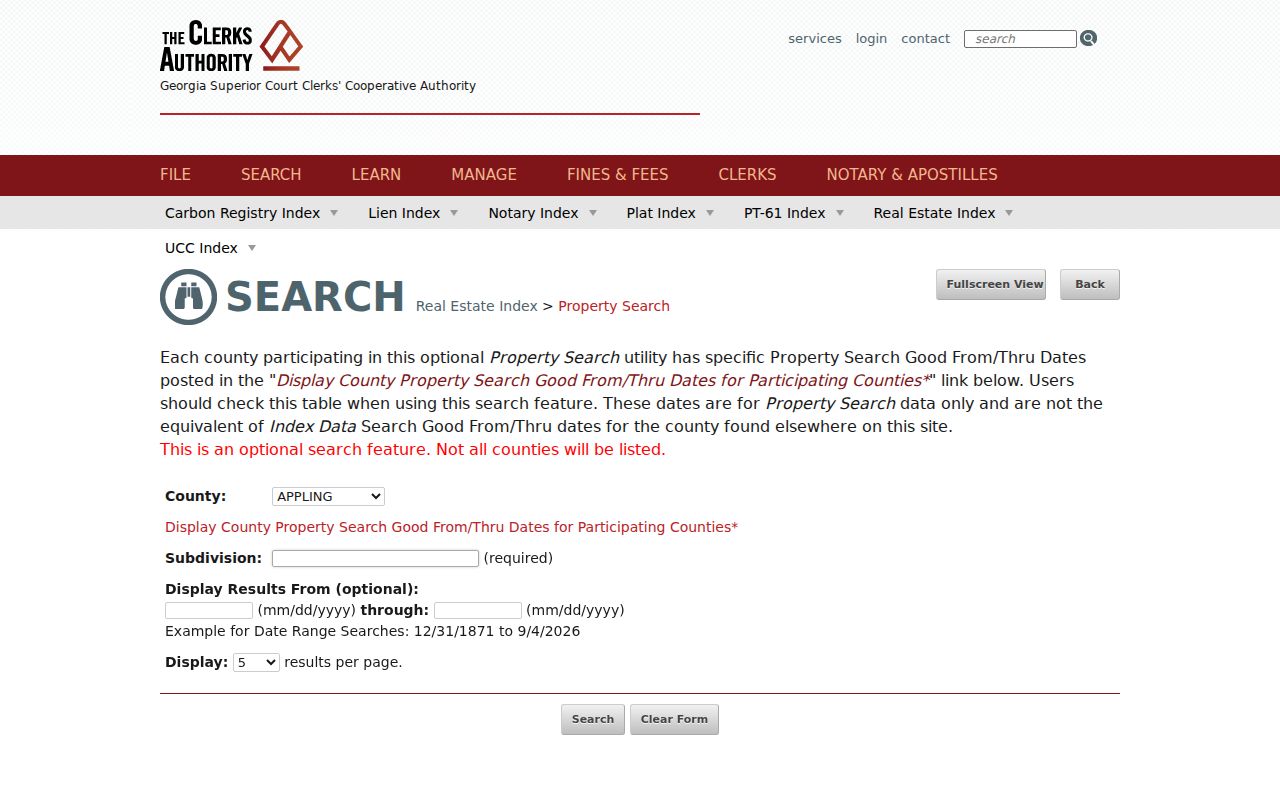
The form shows why the legal description often works better than a street address.
Brooks Plats Bridge the Search
A deed sometimes cites a recorded plat rather than repeating every boundary call. The GSCCCA plat name index gives that reference its own search path. Plats show lots, roads, easements, and the original layout. They do not show the present owner. One Brooks tax-sale file, number 29, tied map/parcel 139M C 3 to Green Meadows Estates Addition 3, Lot 3 Block C, Plat Cabinet 15 Page 151. It also referenced deed 450/627. That file works as a crosswalk between systems, not as proof of current title.
Open the official plat search.
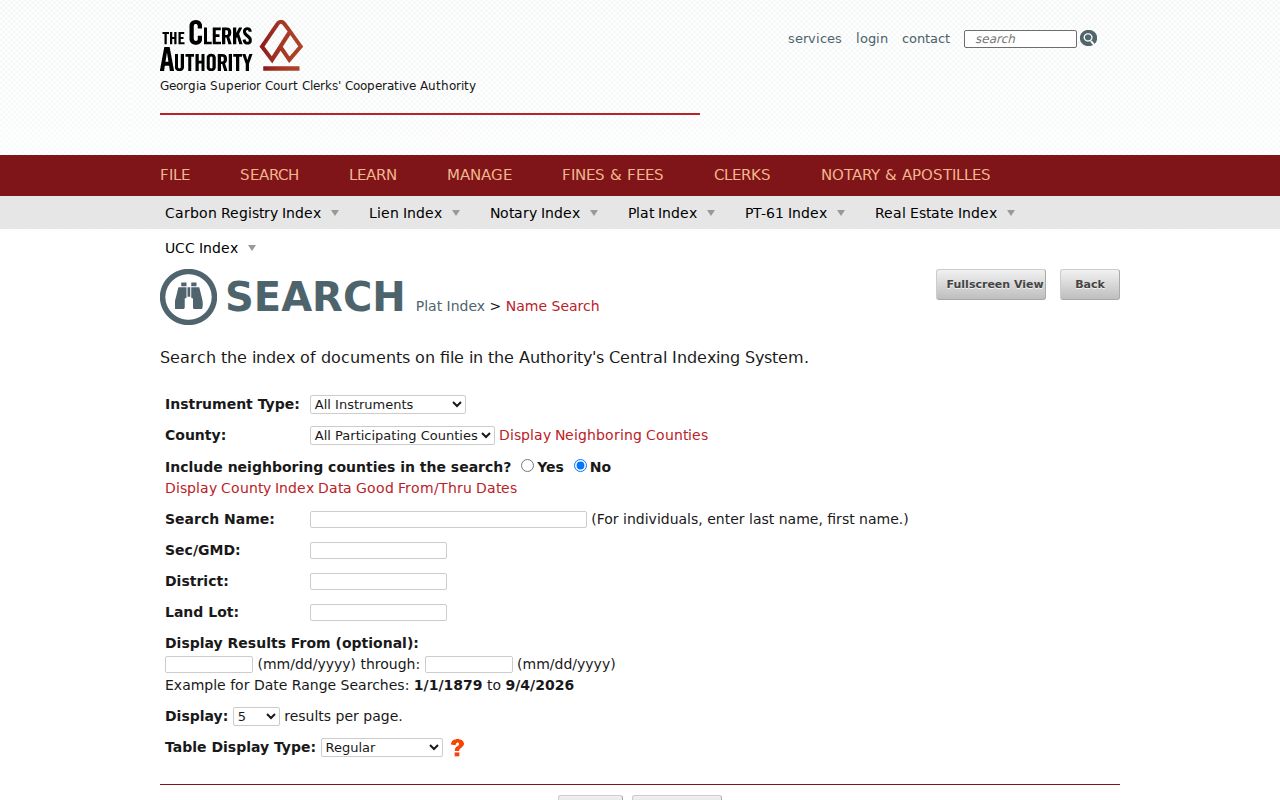
The plat index links the instrument to mapped land without replacing a survey.
Brooks Deeds Before 1988
Deed records before 1988 live in books, indexes, microfilm, and archives held by the clerk. Brooks County was carved from Lowndes and Thomas counties on December 11, 1858. Chase a chain past that date into whichever parent county held the tract. The permanent courthouse, begun in 1859 and finished in 1864, still stands in use. That continuity makes the physical clerk collection essential. Survival of every old volume was never guaranteed, though. Digital Library of Georgia newspapers run from June 1866 through 1994. FamilySearch materials can help too. Together they can pin down an old owner or place. Return to the deed book for proof.
Special Brooks Conveyance Paths
Estates, foreclosures, sheriff's sales, and tax sales can snap a simple buyer-to-seller chain. Probate authority alone is not the new owner's deed. For an estate, the Probate Court identifies the representative. The recorded executor, administrator, or heir deed then shows who took the land. A security deed is just a loan instrument. A foreclosure deed, court order, or tax deed can shift ownership. Yet later redemption, release, quitclaim, or warranty filings can shift it again. Check dates and everything filed afterward. The Tax Commissioner's tax-sale page carries current process material. An old notice is only a snapshot.
Request a Brooks County Deed
Contact the Brooks County Clerk of Superior Court, 1 Screven Street, Suite 6, Quitman, GA 31643, at 229-263-4747. The civil and real-estate fax is 229-263-8054. Include names, the date, deed type, book/page or instrument number, and the legal description. The clerk handles plain and certified copies. The office also keeps older books, and local files that never appear online. The office publishes no current copy-fee schedule, so confirm price and payment first. An Open Records Act request under O.C.G.A. §§50-18-70 et seq. should name existing documents. It should not ask staff to build a title abstract.
Recorded is not guaranteed. Brooks County deed records show filed instruments, not every possible claim or a title opinion. Seek a Georgia attorney or title professional for title certainty.
Match Brooks Deed Descriptions
A single tract in Brooks County can carry more than one legal description. Rural deeds often lean on a land lot, a district, an acreage figure, and boundary calls. Subdivision filings work differently. They cite a recorded lot, block, and a plat book or cabinet with its page. Copy every form exactly as it appears in the instrument. An assessor map number can bridge the deed and the tax roll. Yet it never defines the deed's legal boundary. Street names raise their own trap. Quitman's 1838 town plat carried street names that mostly changed afterward. County permit guidance treats modern 911 addressing as its own separate record. So a failed street search may reflect renaming or reassignment, not a missing deed. Before rejecting a match, compare the old wording carefully. Check the current situs, the plat, and the parcel card. Pavo and Barwick sit close enough to the county line to invite confusion. A city label can point toward either Brooks or Thomas County. Let the legal description and the map decide which recorder holds the filing, never the ZIP code alone. A chain may reach back before Brooks County's 1858 creation. Note why Lowndes or Thomas is being searched as the parent jurisdiction.